|
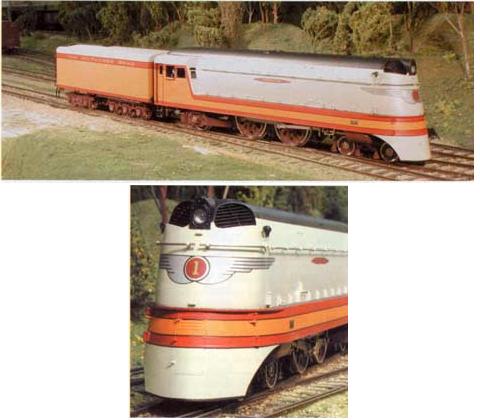
The Milwaukee Road's class F7 comprised six (#100–#105) high-speed, streamlined 4-6-4 "Baltic" or "Hudson" type steam locomotives built by ALCO in 1937–38 to haul the Milwaukee's Hiawatha express passenger trains. Following on from the success of the road's class A 4-4-2s, the F7s allowed the road to haul longer trains on the popular Chicago–Twin Cities routes.
The F7s are major contenders for the fastest steam locomotives ever built, as they ran at over 100 miles per hour (160 km/h) daily. One run in January 1941 recorded by a reporter for Trains magazine saw 110 mph achieved twice—in the midst of a heavy snowstorm. Baron Gérard Vuillet, a French railroading expert, once recorded a run between Chicago and Milwaukee where the locomotive reached 125 mph (201 km/h) and sustained an average 120 mph (190 km/h) for 4.5 miles (7.2 km). However, the British locomotive LNER Class A4 4468 Mallard is generally accepted to be the world's fastest, with a run recorded at 125.88 mph (202.58 km/h) in 1938.
The Milwaukee F7s are accepted as the fastest steam locomotives by a different measure—scheduled speed between stations. In 1939, shortly after they were introduced into passenger service, the Twin Cities Hiawatha schedule was modified such that the engines would need to run the 78.3 mi (126.0 km) between Portage and Sparta, Wisconsin in 58 minutes—a start-to-stop average of 81 mph (130 km/h). comprised six (#100–#105) high-speed, streamlined 4-6-4 "Baltic" or "Hudson" type steam locomotives built by ALCO in 1937–38 to haul the Milwaukee's Hiawatha express passenger trains. Following on from the success of the road's class A 4-4-2s, the F7s allowed the road to haul longer trains on the popular Chicago–Twin Cities routes.
The F7s are major contenders for the fastest steam locomotives ever built, as they ran at over 100 miles per hour (160 km/h) daily. One run in January 1941 recorded by a reporter for Trains magazine saw 110 mph achieved twice—in the midst of a heavy snowstorm. Baron Gérard Vuillet, a French railroading expert, once recorded a run between Chicago and Milwaukee where the locomotive reached 125 mph (201 km/h) and sustained an average 120 mph (190 km/h) for 4.5 miles (7.2 km). However, the British locomotive LNER Class A4 4468 Mallard is generally accepted to be the world's fastest, with a run recorded at 125.88 mph (202.58 km/h) in 1938.
The Milwaukee F7s are accepted as the fastest steam locomotives by a different measure—scheduled speed between stations. In 1939, shortly after they were introduced into passenger service, the Twin Cities Hiawatha schedule was modified such that the engines would need to run the 78.3 mi (126.0 km) between Portage and Sparta, Wisconsin in 58 minutes—a start-to-stop average of 81 mph (130 km/h).
classe di The Road di Milwaukee F7 composta da sei (# 100 - # 105) ad alta velocità, snella 4-6-4 "Baltic" o "Hudson" locomotive a vapore del tipo costruito da ALCO nel 1937-38 per trasportare il Milwaukee treni passeggeri esprimere Hiawatha. Sulla scia del successo di classe della strada A 4-4-2 secondi, la F7s consentito la strada per il traino di treni più lunghi sul popolare Chicago-Twin Cities rotte.
I principali contendenti sono F7s per le locomotive a vapore più veloce mai costruito, mentre correvano a più di 100 miglia all'ora (160 km / h) al giorno. Una corsa nel gennaio del 1941 registrato da un giornalista per la rivista I treni visto 110 mph raggiunti due volte nel bel mezzo di una tempesta di neve pesante. Baron Gérard Vuillet, un esperto di railroading francese, una volta registrata una corsa tra Chicago e Milwaukee, dove la locomotiva ha raggiunto 125 mph (201 km / h) e sostenuta in media 120 mph (190 km / h) per 4,5 miglia (7,2 km). Tuttavia, i britannici locomotiva LNER Classe A4 4.468 Mallard è generalmente accettato di essere il più veloce al mondo, con una corsa registrati a 125,88 mph (202,58 chilometri all'ora) nel 1938.
Il F7s Milwaukee sono accettate come le locomotive a vapore più veloce da una velocità diversa misura di linea tra le stazioni. Nel 1939, poco dopo che erano stati introdotti in servizio passeggeri, il Twin Cities Hiawatha calendario è stato modificato in modo tale che i motori avrebbero bisogno di eseguire il 78,3 miglia (126,0 km) tra Portage e Sparta, Wisconsin in 58 minuti-per uno start-stop- media di 81 mph (130 km / h). composto da sei (# 100 - # 105) ad alta velocità, snella 4-6-4 "Baltic" o "Hudson" locomotive a vapore del tipo costruito da ALCO nel 1937-38 per trasportare il Milwaukee treni passeggeri esprimere Hiawatha. Sulla scia del successo di classe della strada A 4-4-2 secondi, la F7s consentito la strada per il traino di treni più lunghi sul popolare Chicago-Twin Cities rotte.
I principali contendenti sono F7s per le locomotive a vapore più veloce mai costruito, mentre correvano a più di 100 miglia all'ora (160 km / h) al giorno. Una corsa nel gennaio del 1941 registrato da un giornalista per la rivista I treni visto 110 mph raggiunti due volte nel bel mezzo di una tempesta di neve pesante. Baron Gérard Vuillet, un esperto di railroading francese, una volta registrata una corsa tra Chicago e Milwaukee, dove la locomotiva ha raggiunto 125 mph (201 km / h) e sostenuta in media 120 mph (190 km / h) per 4,5 miglia (7,2 km). Tuttavia, i britannici locomotiva LNER Classe A4 4.468 Mallard è generalmente accettato di essere il più veloce al mondo, con una corsa registrati a 125,88 mph (202,58 chilometri all'ora) nel 1938.
Il F7s Milwaukee sono accettate come le locomotive a vapore più veloce da una velocità diversa misura di linea tra le stazioni. Nel 1939, poco dopo che erano stati introdotti in servizio passeggeri, il Twin Cities Hiawatha calendario è stato modificato in modo tale che i motori avrebbero bisogno di correre il 78,3 miglia (126,0 km) tra Portage e Sparta, Wisconsin in 58 minuti-per uno start-stop-media di 81 mph (130 km / h).
First! Again and Again
-- The Milwaukee Road!
First line between Chicago and the Twin Cities -(Minneapolis and Saint Paul )- the only double tracked route.
First and only road to operate over its own rails all the way from Chicago to the North Pacific Coast.
First to adopt roller bearings for through passenger trains.
First to operate all-steel trains between Chicago and the Twin Cities; between Chicago and Seattle-Tacoma.
First to use open observation cars on transcontinental trains
First to use steam heat and electric lights on trains between Chicago and the Twin Cities.
First to operate long distance trains by electric power.
First with radio between Chicago and the Twin Cities.
First with coil spring mattresses.
First with streamstyled luxury coaches one-third lighter than standard and offering one-third more room per passenger.
And Now - -
First to have designed and built a streamlined, highspeed steam locomotive.
First to introduce a completely streamstyled super speed train of the light-heavyweight type.
First with buffet section such as is exemplified in the Tip Top Tap Room.
First with a Beaver Tail rear-end car.
|

 Login
Login Iscriviti
 Home
Home FAQ
FAQ Cerca
Cerca