Se dici che il plastico è pulito non è cattiva captazione da sporco (potrebbe essere da ossido ... che armamento usi? Oppure da binari mal posati dove non tutte le ruote appoggiano in maniera corretta).
Ma quello che mi lascia perplesso sono gli "strappi" che citavi ... che non sono compatibili con un discorso captazione (ne di corrente ne di segnale DCC)... se fosse captazione la macchina al ritorno della corrente partirebbe alla velocità minima per poi aumentare fino al valore richiesto.
Ora l'ESU standard è un decoder che, da un punto di vista di qualità di marcia è altrettanto valido del più programmabile V4 e quindi non ci dovrebbero essere problemi.
I parametri da regolare sono questi:
- velocità minima, media e massima (rispettivamente CV2, CV6 e CV5)
- parametri di funzionamento del controllo di carico (regolarità di marcia ovvero CV53, CV54, CV55)
Compaiono così nel Lokprogrammer specificando "Standard" come decoder:
Allegato:
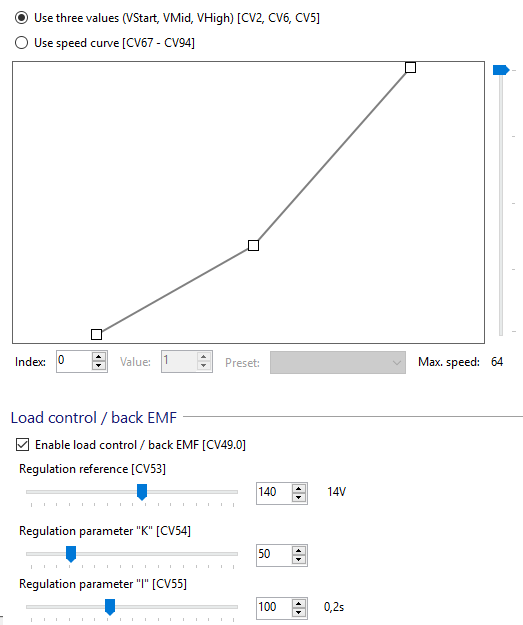 2016-07-23.png [ 22.31 KiB | Osservato 6322 volte ]
Andando da quelli più critici a quelli meno abbiamo:
CV54 - effetto della regolazione di caricoCita:
Parameter „K“, stored in CV 54, influences how strongly load control will affect the driving performance.
The higher the value, the more load control will respond to any changes and try to adjust the revs of the motor.
Parameter „K“ needs adjustment if the locomotive runs unevenly (jerks) in speed step 1.
Reduce the value of CV 54 by 5 and test-run the locomotive to see if there are any improvements.
Repeat these steps until the locomotive runs smoothly at speed step 1.
Traduco (alla meglio)...
Cita:
Il parametro K, memorizzato nella CV54, regola l'intensità dell'effetto della regolazione di carico sulle carateristiche di marcia.
Più alto il valore maggiore sarà l'intervento del controllo di carico per rispondere ad ogni cambiamento e cercare di regolare i giri del motore.
Il Parametro K necessita di regolazione se la locomotiva marcia irregolarmente (scatti) al primo step di velocità.
Ridurre il valore della CV54 di 5 e riprovare per vedere se ci sono miglioramenti.
Ripetere questi passi fin quando la locomotiva marcia regolarmente al primo step di velocità.
La cv54 parte a 50 (valore secondo me un poco alto).
CV55 - quantità di inerziaCita:
Parameter „I“, stored in CV 55 provides important information to the decoder on how much inertia the motor has. Motors with large flywheels naturally have more inertia than smaller ones or coreless motors.
Adjust parameter „I“ if the locomotive jerks somewhat just before it stops or „jumps“ at lower speeds (lower third of the speed step range) or simply does not run smoothly.
- Reduce the value by 5 starting with the default value for motors with very small or no flywheels.
- Increase the value by 5 starting with the default value for motors with large flywheels.
Test again and repeat this procedure until you arrive at the desired result.
CV53 - voltaggio di riferimentoCita:
In CV 53, you set the EMF reference voltage generated by the motor at maximum revs. This parameter may have to be adapted subject to the track voltage and the efficiency of the motor.
If the locomotive reaches maximum speed when the throttle is set to about a third and the top third of the throttle has no influence on the speed, then you should reduce the value of CV 53. Reduce the value by 5 – 8 and test the locomotive again.
Repeat this process until the locomotive just reaches its maximum speed when the throttle is fully open.
Nell'ordine io modificherei per gradi prima la cv54 e quindi, se serve, la CV55 ... infine proprio per perfezionismo la CV53.
Poi a gusto, la CV2 (velocità minima) e la CV5 (velocità massima).
Questo in teoria (e per tua cultura) .... vista però la stranezza di comportamento ritengo fondamentale che tu faccia delle prove solo loco e solo centralina su uno spezzone di rotaia separato da tutto proprio per eliminare tutti gli altri fattori. Se la macchina in queste condizioni non strappa ci sono problemi sul plastico e il "tuning" potrebbe non risolvere il problema.

 Login
Login Iscriviti
 Home
Home FAQ
FAQ Cerca
Cerca






 a trippa ce l ho già messa da quello ho visto che il primo asse non prende corrente.